Foreclosing the Future: The World Bank and the Politics of Environmental Destruction by Bruce Rich
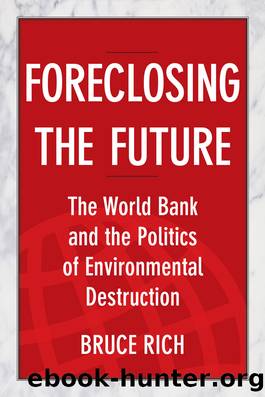
Author:Bruce Rich [Rich, Bruce]
Language: eng
Format: epub
Tags: science, Environmental Science, law, International, environmental, Earth Sciences, Geography, Global Warming & Climate Change, General, Business & Economics, Development, Sustainable Development, Social Science, Human Geography
ISBN: 9781610911849
Google: 9fXtnAEACAAJ
Publisher: Island Press/Center for Resource Economics
Published: 2013-11-26T23:41:51.761520+00:00
CHAPTER NINE
A Market Like No Other
HISTORY MAY WELL JUDGE the Bankâs role in subsidizing global carbon markets as an ill-advised and quixotic foray into the early-twenty-first-century equivalent of the seventeenth-century speculative bubble in tulip-bulb futures. Here the seductive lure was not to purchase a whole house in Amsterdam for the price of a single rare tulip bulb (as was the case at the peak of the infamous Dutch financial bubble in tulip futures), but to unleash a global carbon market whereby businesses in developed countries would pay tens of billions of dollars a year for activities in poorer countries to offset rich-country greenhouse-gas (GHG) emissions. Superficially, it seemed plausible enough; after all, major industrialized country governments were pushing the scheme, and they gave the Bank still more money to help catalyze it.
The Clean Development Mechanism, and the much smaller Joint Implementation mechanism (or JI, established under the Kyoto Protocol to buy carbon offsets in post-communist economies in transition), were the only global carbon trading offset mechanisms officially recognized by any governments, namely by the governments of the European Union. We noted earlier that the Bankâs carbon trust funds were financed by new, additional contributions from the governments in the industrialized countries, particularly the Europeans, who clearly had an interest in the success of CDM and JI, as a way for them to meet their emissions-reduction targets more cheaply. In 2000 the Bank set up the Prototype Carbon Fund (PCF), to be followed by 13 other funds over the next 11 years. Some focused, for example, on smaller GHG offset projects that supposedly would help community development or forest conservation, and others were separate carbon funds financed by individual countriesâthe Netherlands, Spain, Denmark, and Italy. The largest was the Umbrella Carbon Facility, launched in 2006 with a final capitalization of over 914 million euros (nearly $1.2 billion). By the end of its fiscal year 2011, the Bank claimed it was managing some $3 billion in its various carbon funds.1
CDM projects, we recall, were allowed by the Kyoto Protocol to help achieve GHG reductions less expensively by allowing rich countries to meet part of their requirements in poorer nations, but Kyoto also required that the projects bring local sustainable-development benefits.2 Unfortunately, the CDM turned out to be a major failure in terms of both goals, and the Bankâs carbon funds played a significant role in contributing to that failure.
The central concept of the CDM was climate âadditionality,â i.e., that a project really was reducing emissions that otherwise would have taken place in the recipient developing country, and that the project would not have been built without the extra subsidy. In practice it was extraordinarily difficult to prove whether a particular CDM subsidized project, say, a wind farm in India or a hydroelectric project in China, would or would not have been built but for the CDM subsidy, and whether it would displace a cheaper, climate-unfriendly investment, such as a coal plant. Indeed, the major developing countries that would host most of the
Download
This site does not store any files on its server. We only index and link to content provided by other sites. Please contact the content providers to delete copyright contents if any and email us, we'll remove relevant links or contents immediately.
| Anthropology | Archaeology |
| Philosophy | Politics & Government |
| Social Sciences | Sociology |
| Women's Studies |
Born to Run: by Christopher McDougall(7132)
The Leavers by Lisa Ko(6952)
iGen by Jean M. Twenge(5419)
Sapiens by Yuval Noah Harari(5375)
Spare by Prince Harry The Duke of Sussex(5202)
The Kite Runner by Khaled Hosseini(5188)
Machine Learning at Scale with H2O by Gregory Keys | David Whiting(4317)
Bullshit Jobs by David Graeber(4197)
Never by Ken Follett(3963)
Goodbye Paradise(3813)
Livewired by David Eagleman(3778)
Fairy Tale by Stephen King(3403)
A Dictionary of Sociology by Unknown(3088)
Harry Potter 4 - Harry Potter and The Goblet of Fire by J.K.Rowling(3077)
The Social Psychology of Inequality by Unknown(3039)
The Club by A.L. Brooks(2930)
Will by Will Smith(2930)
0041152001443424520 .pdf by Unknown(2850)
People of the Earth: An Introduction to World Prehistory by Dr. Brian Fagan & Nadia Durrani(2740)
